
ISO 20653.
ISO 20653 specifies the requirements for IP codes applied to electrical equipment in road vehicles, providing protection against foreign objects, water and access. It extends the IEC 60529 framework with vehicle-specific test conditions.
About this standard.
ISO 20653 is the international standard that defines ingress protection (IP) ratings specifically for road vehicles. While IEC 60529 establishes the general IP code framework used across all electrical equipment, ISO 20653 adapts and extends that framework for the harsher environmental conditions that vehicle-mounted equipment encounters — pressure-jet washing, high-temperature jet cleaning, salt spray, dust laden with road debris and prolonged exposure to standing water.
ISO 20653 is the road-vehicle dialect of the IP code. It uses the same two-digit structure as IEC 60529, but adds vehicle-specific test conditions, introduces an additional digit for vehicle-side application and references the IPX9K high-temperature, high-pressure jetting test that is now widely used outside the automotive sector as well.
Scope
ISO 20653 specifies degrees of protection provided by enclosures of electrical equipment installed on road vehicles — passenger cars, commercial vehicles, off-highway equipment and powered two-wheelers. It applies to components mounted in the engine compartment, on the chassis, on the underbody, in wheel arches, on the exterior surface and inside the vehicle.
The standard does not specify which IP rating a particular component must achieve — that decision belongs to the vehicle manufacturer, the system integrator or the relevant OEM specification. ISO 20653 defines how the test is performed and what each digit means in the road-vehicle context.
IP code structure
The ISO 20653 IP code uses the same two-digit format as IEC 60529, with an optional letter for the application area on the vehicle:
IP X X K
   │ │ │
   │ │ └─ Optional supplemental letter (K = additional jetting per §3.5)
   │ └─── Second digit: protection against liquid ingress (0 to 9K)
   └───── First digit: protection against solid foreign objects (0 to 6)
First digit — solid object protection
The first digit follows the IEC 60529 convention with vehicle-specific test conditions for the dust-tight categories.
- IP0X — No protection
- IP1X to IP4X — Progressively smaller solid object exclusion
- IP5X — Dust-protected; some dust ingress permitted but cannot impair operation
- IP6X — Dust-tight; no dust ingress
For categories 5 and 6, the dust chamber test conditions include vacuum cycling appropriate for vehicle-mounted electronics where pressure changes occur during operation.
Second digit — liquid ingress protection
This is where ISO 20653 diverges most significantly from IEC 60529, particularly at the high end of the scale.
- IPX0 — No protection
- IPX1, IPX2 — Vertical and slightly tilted dripping water
- IPX3 — Spray water from defined angles
- IPX4 — Splash water from any direction
- IPX4K — Splash water with increased pressure (vehicle-specific)
- IPX5 — Low-pressure water jets from any direction
- IPX6 — Powerful water jets from any direction
- IPX6K — Powerful water jets at higher pressure than IPX6 (vehicle-specific)
- IPX7 — Temporary immersion (defined depth, defined duration)
- IPX8 — Continuous immersion (manufacturer-defined conditions, more severe than IPX7)
- IPX9K — High-temperature, high-pressure water jetting
The IPX9K test is the most distinctive feature of ISO 20653. It simulates the high-pressure, high-temperature steam-cleaning conditions used in commercial vehicle washing and engine bay cleaning.
IPX9K conditions per ISO 20653 §5.2: 80 °C ± 5 °C water, 80 to 100 bar pressure, 14 to 16 L/min flow, nozzle distance 100 to 150 mm, four nozzle angles, 30 s exposure per angle.
Test methods
Dust testing (IP5X, IP6X)
- Equipment: Dust chamber with talcum powder per defined particle size distribution
- Procedure: Sample sealed in chamber with controlled dust circulation; vacuum cycles may be applied for category 6 components
- Duration: Defined per category and component type
- Acceptance: Visual inspection after test; for IP6X, no dust ingress is permitted
Water testing — IPX3 to IPX6K
These tests use spray nozzles, oscillating tubes and jet nozzles defined with specific geometries, flow rates and pressures.
- IPX3, IPX4: Oscillating tube or spray nozzle, controlled water flow over defined sample orientations
- IPX4K: Spray with elevated pressure compared to IPX4
- IPX5, IPX6: Hand-held jet nozzle with defined internal diameter, applied to all sample surfaces from the specified distance
- IPX6K: Higher pressure than IPX6, vehicle-specific
Immersion testing — IPX7 and IPX8
- IPX7: Sample immersed in fresh water at specified depth and duration
- IPX8: More severe immersion conditions defined by the manufacturer — depth, duration, water composition or all three
High-pressure, high-temperature jetting — IPX9K
This is the signature test of ISO 20653. The test simulates high-pressure steam-cleaning equipment used on commercial vehicles and engine compartments.
- Equipment: Specialised IPX9K jetting fixture with four fan-jet nozzles
- Nozzle angles: 0°, 30°, 60° and 90° relative to sample
- Sample rotation: Continuous rotation during test
- Conditions: 80 °C ± 5 °C water, 80 to 100 bar pressure, 14 to 16 L/min flow, 100 to 150 mm nozzle distance, four nozzle angles, 30 s per angle (ISO 20653 §5.2).
- Application: Mandatory or recommended for many vehicle-exterior and engine-bay components
Applicability
- Cabin interior, non-exposed wiring: IP4X to IP5X / IPX0 to IPX2
- Cabin floor, footwell areas: IP5X / IPX4
- Underbody, wheel arch: IP6K / IPX6K to IPX9K
- Engine compartment: IP6K / IPX7 to IPX9K
- Exterior body, lamp assemblies: IP6K / IPX6 to IPX9K
- Submersible components (e.g. fording sensors): IP6K / IPX8 to IPX9K
The specific rating required for a given component is normally set by the vehicle OEM or by the platform specification.
Related standards
- IEC 60529 — General IP code; ISO 20653 builds on this framework and references many of its definitions
- ISO 16750 — Road vehicle environmental conditions and testing — broader environmental test plan referencing IP protection alongside vibration, temperature, EMC
- DIN 40050-9 — Earlier German standard for vehicle IP protection; superseded but still referenced in legacy specifications; introduced IPX9K test geometry
- SAE J1455 — North American counterpart for heavy-duty vehicle component environmental requirements; uses similar IP framework with adaptations
- MIL-STD-810 Method 506 (Rain) — Defense rain testing, parallel framework but different geometries
- IEC 60068-2-18 — Water test methods used in some component-level qualification chains
Engineering implications
ISO 20653 compliance is rarely about a single sealing failure — it surfaces design and assembly issues that are easier to address before tooling than after.
Common failure modes traced back to design decisions:
- Connector sealing: Connector orientation, drainage paths, gasket selection and mating tolerance
- Membrane vents: Pressure equalisation vents that fail under IPX9K jet impingement
- Cable entry glands: Strain relief geometry, cable jacket material, gland sealing surface preparation
- Enclosure parting lines: O-ring groove geometry, compression set tolerance, fastener torque
- PCB conformal coating: Coverage of pin headers, edge contacts and component leads against high-pressure water exposure
For vehicle-exterior and engine-bay components, a pre-compliance IP test campaign at the prototype stage typically reveals the highest-risk failure modes before tooling investment, when corrective action is still affordable in design rather than process change.
Equipment for this standard.
View all equipment →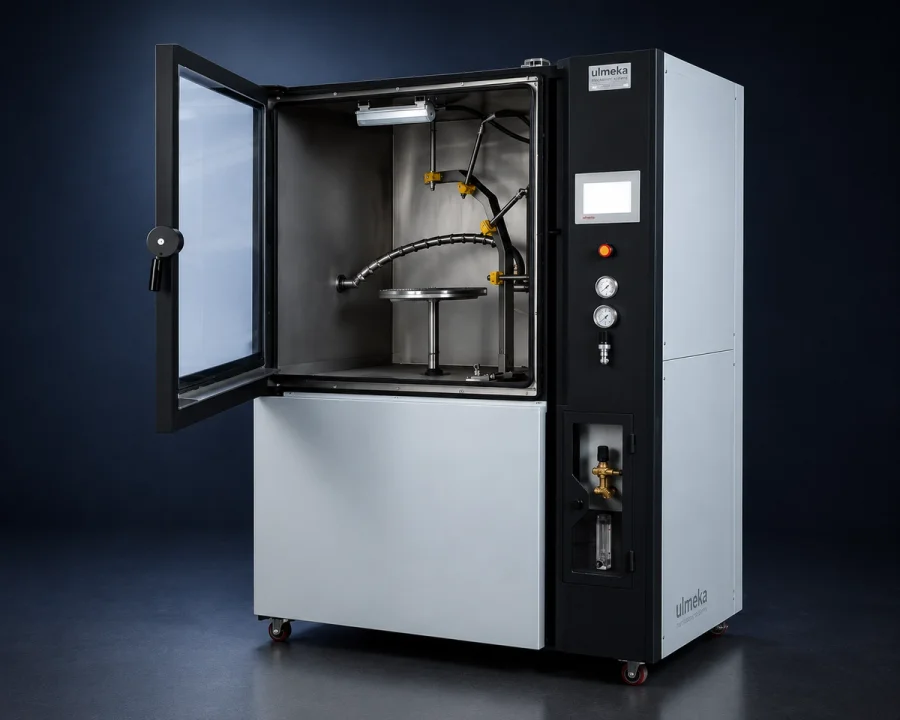
ULMEKA engineers test systems
to specification.
If your requirement is outside this catalogue — custom chamber sizes, combined-standard integration, or tailored test profiles — talk to our engineering team.