
IEC 60335.
IEC 60335 specifies safety requirements for household and similar electrical appliances. IEC 60335-1 gives the general requirements; the IEC 60335-2 series adds particular requirements for specific appliance categories. Testing covers mechanical, electrical, thermal and durability requirements.
About this standard.
Overview
IEC 60335 is the international family of safety standards for household and similar electrical appliances, published by the IEC. It is structured in two layers: IEC 60335-1 sets the general safety requirements that apply to all appliances, while the IEC 60335-2 series adds particular requirements for specific categories such as kitchen machines, heating appliances and motor-operated tools.
The standard verifies that an appliance stays safe under both normal use and reasonably foreseeable misuse. It addresses protection against electric shock, fire, mechanical and thermal hazards, and the durability of the materials and connections that hold those protections in place across the product's life — which makes 60335 testing a core market-access step for electrical appliances.
Scope & Applicability
IEC 60335 applies to the safety of electrical appliances intended for household and similar use, whether sold to consumers or used in light commercial settings such as shops, offices and farms. Part 1 covers appliances supplied from the mains or a battery within defined voltage limits; the Part 2 series then refines these rules for individual appliance types, so a given product is assessed against Part 1 together with the relevant Part 2-xx.
Because each particular part inherits and adapts the general clauses, conformity testing reads as a combined requirement: the general safety baseline plus the category-specific deviations. This layered structure is why a manufacturer first identifies the correct Part 2 for the product, then tests against both documents in parallel.
Test Methods
Verification under IEC 60335 groups into several hazard families, each examined under normal operation and under reasonably foreseeable fault or abnormal conditions:
- Electrical safety and insulation — protection against electric shock, leakage current, electric strength, and adequate creepage and clearance distances.
- Heating and abnormal operation — temperature rise of parts and surfaces under normal load and under simulated fault conditions, so the appliance does not become a hazard when it fails.
- Mechanical strength and construction — resistance of enclosures and live-part guards to impact, the robustness of internal wiring, and the integrity of the supply connection and external flexible cords.
- Resistance to heat and fire — thermal stability and ignition behaviour of non-metallic and insulating parts, assessed with established apparatus such as the glow-wire, needle-flame and ball-pressure tests.
The exact temperatures, forces, currents and durations for each check are fixed by the applicable clause and part, so test rigs are configured to the specific appliance category under assessment.
Related Standards
In Europe the standard is adopted as the EN 60335 series and is widely referenced for CE-related conformity; comparable national adoptions exist in other markets. Within the family, IEC 60335-1 is the anchor document, while more than a hundred Part 2-xx documents extend it to specific appliance categories — which is why "IEC 60335" on a datasheet always implies a Part 1 + Part 2 combination rather than a single test.
Testing with ULMEKA
ULMEKA Mechatronics designs and manufactures test apparatus used to verify specific IEC 60335 requirements, including mechanical-strength, internal-wiring and supply-connection checks, as well as fire-resistance apparatus shared with related electrical-safety standards. The equipment below is configured to the relevant clause and appliance category; for a specific testing need, the requirements are confirmed at the proposal stage.
Test methods.
Equipment for this standard.
View all equipment →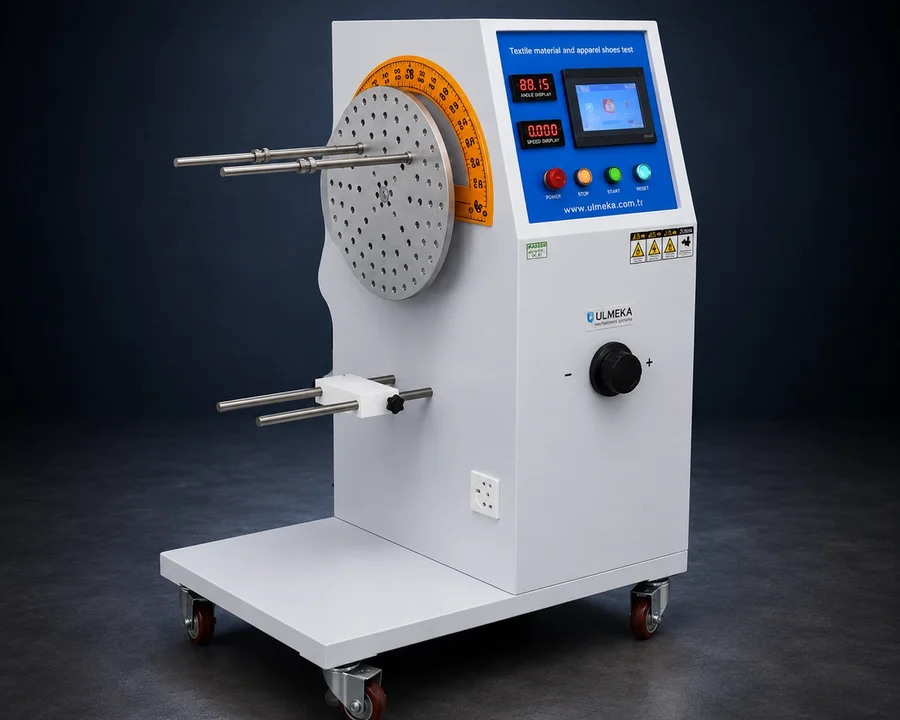
ULMEKA engineers test systems
to specification.
If your requirement is outside this catalogue — custom chamber sizes, combined-standard integration, or tailored test profiles — talk to our engineering team.