
IEC 60112.
IEC 60112 defines the method for determining the comparative and proof tracking indices of solid insulating materials under wet, contaminated conditions.
About this standard.
Overview
IEC 60112 defines the method for measuring how well a solid insulating material resists the formation of conductive tracks on its surface when exposed to electrical stress and contamination. The result is expressed as a comparative tracking index (CTI) or proof tracking index (PTI) — a voltage value that lets designers compare and select materials.
Tracking is a common failure mode in real equipment: over time, moisture and dirt on an insulating surface can let small currents flow, gradually carbonising a conductive path that can lead to short circuits or fire. IEC 60112 reproduces this mechanism in a controlled, repeatable test so a material's resistance to it can be quantified.
Scope & Applicability
The standard applies to solid electrical insulating materials used in components and equipment where surfaces may become contaminated in service. Its index values feed directly into other safety standards, which often specify a minimum CTI for the insulation used at particular voltages or in particular pollution conditions, so material selection can be justified against a recognised figure.
Because the index reflects a material rather than a finished product, a single tracking test characterises an insulating compound that may then be used across many different designs, which is why material datasheets routinely quote a CTI value.
Test Methods
The test recreates surface contamination under voltage and observes when a conductive track forms:
- Comparative tracking index (CTI) — a contaminant solution is dripped between two electrodes on the material surface while voltage is applied, and the highest voltage the material withstands for a defined number of drops without tracking is recorded.
- Proof tracking index (PTI) — the material is verified to withstand a specified voltage for the defined number of drops, confirming it meets a required class rather than finding its maximum.
The voltages, electrode geometry, contaminant solution and drop count are all fixed by the standard, so results from different laboratories can be compared directly.
Related Standards
IEC 60112 is rarely an end in itself; its CTI and PTI values are referenced by many product-safety standards — for appliances, luminaires, switchgear and electronic equipment — whenever they set minimum tracking-resistance requirements for insulation. The standard therefore underpins material choices across a wide range of electrical products.
Testing with ULMEKA
ULMEKA Mechatronics designs and manufactures tracking-index test apparatus used to determine CTI and PTI values to IEC 60112, configured to the voltages and contaminant conditions the standard defines. The equipment below covers these checks; for a specific testing need, the requirements are confirmed at the proposal stage.
Test methods.
Equipment for this standard.
View all equipment →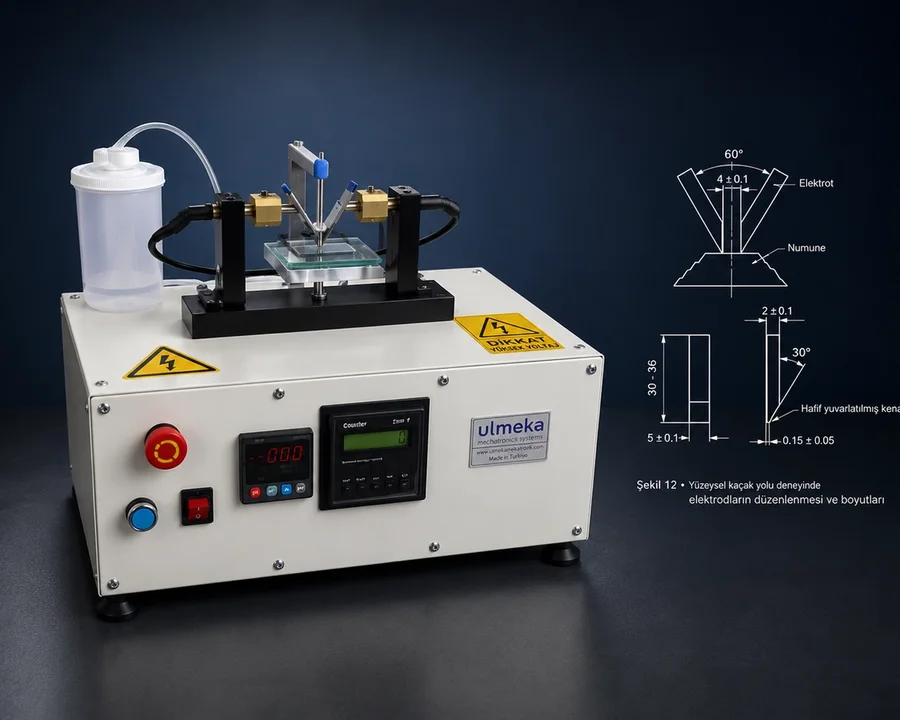
ULMEKA engineers test systems
to specification.
If your requirement is outside this catalogue — custom chamber sizes, combined-standard integration, or tailored test profiles — talk to our engineering team.