
IEC 60068-2.
IEC 60068-2 is a series of international standards providing fundamental procedures for environmental testing of electrotechnical products. Individual parts cover specific stresses such as cold, dry heat, damp heat, vibration and shock.
About this standard.
IEC 60068-2 is the international reference series for environmental test methods applied to electrotechnical products. The "-2" series defines the individual test procedures referenced by product committees, automotive consortia, defense specifications and aerospace qualification bodies. Each part covers one environmental stress — temperature, humidity, vibration, shock, salt mist, free fall, low pressure — and prescribes the conditions, instrumentation tolerances and procedural steps required for repeatable laboratory testing.
IEC 60068-2 provides the building-block test methods that other compliance frameworks reference instead of redefining. When MIL-STD-810, RTCA DO-160, ISO 16750 or product-specific IEC standards specify a vibration, thermal cycle or damp heat test, the underlying procedure usually points back to an IEC 60068-2 part.
Scope
The series targets electrical and electronic equipment, components, sub-assemblies and finished products that must demonstrate environmental robustness in the field. It does not prescribe equipment categorisation or pass/fail limits — those are set by the product committee or end-user specification. IEC 60068-2 standardises how a test is performed, not whether a given product must pass it.
The current published structure splits into:
- IEC 60068-1 — general principles, terminology, severity selection guidance
- IEC 60068-2-x — individual test methods (climatic, mechanical, combined)
- IEC 60068-3-x — supporting documents (background information, guidance)
This page covers the test methods most frequently referenced in defense, aerospace, automotive and industrial product qualification.
Test methods
The methods below are grouped by stress type. Each entry lists the test code, common designation, principle of operation and the equipment configuration typically required.
Climatic tests
IEC 60068-2-1 — Cold
- Purpose: Determine the ability of components and equipment to withstand and operate at low temperature
- Typical conditions: Steady-state low temperature exposure; IEC 60068-2-1 defines classes typically from −5 °C to −65 °C, with lower extremes used in aerospace.
- Procedures: Method Ab (gradual change, non-dissipating equipment), Method Ad (gradual change, dissipating equipment)
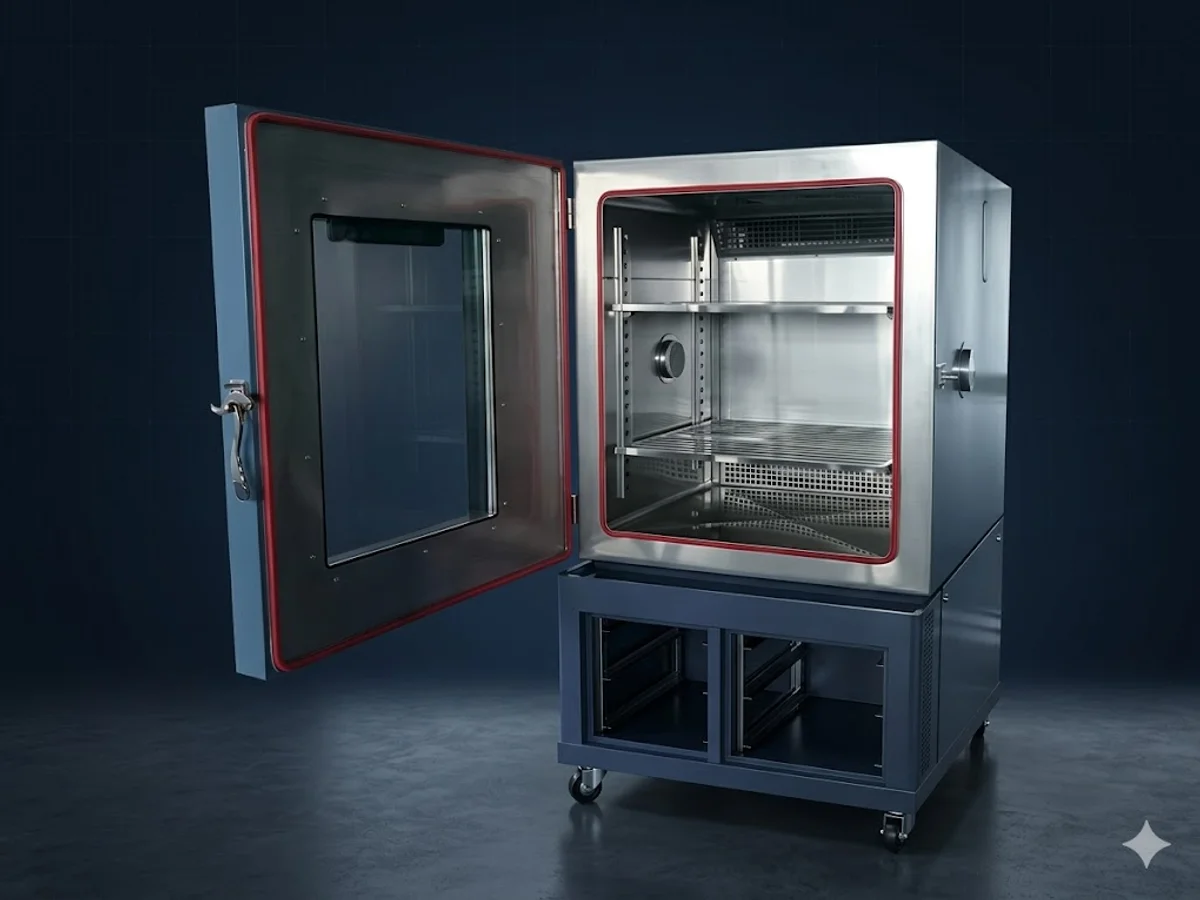
- Equipment: Climatic chamber with active cooling and forced air circulation
IEC 60068-2-2 — Dry heat
- Purpose: Verify equipment integrity and function under elevated temperature without humidity
- Typical conditions: Steady-state high temperature; severity selected from a defined preferred series
- Procedures: Method Bb (gradual change), Method Bd (with heat dissipation)
- Equipment: Climatic chamber capable of stable high temperature with controlled ramp rates
IEC 60068-2-14 — Change of temperature
- Purpose: Assess response to temperature transitions, including thermal shock and gradual change
- Procedures: Method Na (rapid change, two chambers), Method Nb (gradual change, single chamber)
- Application: Components subject to operational thermal cycling, transport between environments
IEC 60068-2-30 — Damp heat, cyclic
- Purpose: Test for moisture absorption, condensation and corrosion under cyclic humidity
- Typical conditions: 24-hour cycles with high temperature and high relative humidity, condensation phase per cycle
- Application: Outdoor equipment, equipment exposed to diurnal temperature variation
IEC 60068-2-38 — Composite temperature and humidity cyclic
- Purpose: Combined temperature and humidity stress to reveal failure modes not detected by individual climatic tests
- Application: Electronics, sealed assemblies, conformal-coated PCBs
IEC 60068-2-52 — Salt mist, cyclic
- Purpose: Evaluate corrosion resistance and electrical degradation in marine and coastal atmospheres
- Procedure: Cyclic exposure to salt fog and humidity controlled drying phases
- Application: Marine, naval, coastal industrial equipment; photovoltaic and solar modules in coastal installations
IEC 60068-2-78 — Damp heat, steady state
- Purpose: Long-duration constant humidity exposure for moisture ingress and surface degradation
- Typical conditions: Steady high temperature and high relative humidity, typically 21 to 56 days per IEC 60068-2-78 severity table.
Mechanical tests
IEC 60068-2-6 — Sinusoidal vibration
- Purpose: Determine equipment response to single-frequency vibration encountered in transport and operation
- Test parameters: Frequency range, amplitude and number of sweeps per axis selected from severity table
- Procedure: Frequency sweep through the selected band at controlled rate (typically 1 octave per minute), three orthogonal axes
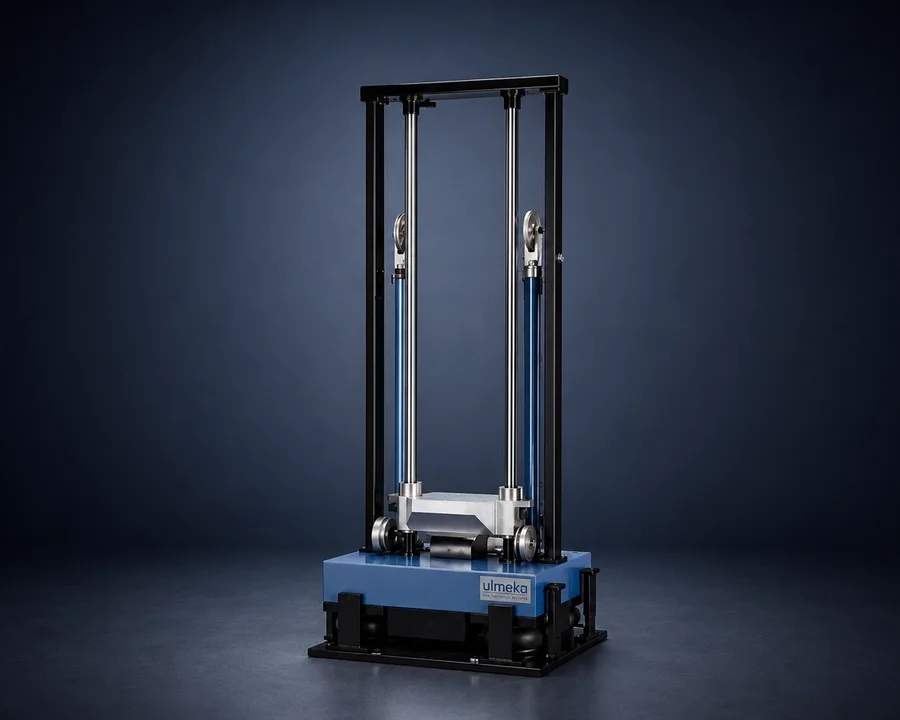
- Equipment: Electrodynamic or hydraulic shaker with closed-loop control
IEC 60068-2-27 — Shock
- Purpose: Verify resilience to mechanical shocks from handling, transport and operational events
- Pulse shapes: Half-sine, sawtooth and trapezoidal pulses defined; peak acceleration and pulse duration selected from severity table
- Procedure: Defined number of pulses applied in each direction along each orthogonal axis
IEC 60068-2-31 — Drop and topple
- Purpose: Evaluate the ability to withstand drops typical of rough handling
- Application: Portable equipment, handheld electronics, packaged goods during transit
IEC 60068-2-64 — Broadband random vibration
- Purpose: Reproduce the random vibration spectrum encountered in real transport and operational environments
- Procedure: Power spectral density profile selected from severity table, applied along each orthogonal axis for the specified duration
- Application: Aerospace, military, automotive electronics — random vibration is generally more realistic than sinusoidal for service environments
Combined and special tests
IEC 60068-2-39 — Combined sequential cold, low pressure, damp heat
- Purpose: Sequenced stress profile representing high-altitude environment exposure followed by humid descent
- Application: Avionics, missile components, equipment exposed to altitude excursions
IEC 60068-2-11 — Salt mist (continuous)
- Purpose: Continuous salt fog exposure for accelerated corrosion screening
- Application: Components and finishes evaluated for marine atmospheric resistance
Applicability
- Defense: -1, -2, -6, -14, -27, -30, -38, -64 (cross-referenced from MIL-STD-810)
- Aerospace: -6, -27, -64, -39 (RTCA DO-160 cross-reference)
- Automotive: -1, -2, -6, -14, -27, -30, -64 (ISO 16750 cross-reference)
- Industrial electronics: -1, -2, -14, -27, -30, -78
- Marine: -52, -11, -30
- Photovoltaic and solar: -52, -78 (cross-reference from IEC 61215)
The series is the foundation layer. Most product-level qualification specifications do not redefine the underlying environmental test — they select a method from IEC 60068-2 and specify severity, duration and acceptance criteria appropriate to the product.
Related standards
- IEC 60068-1 — General principles, terminology and severity selection
- MIL-STD-810 — Defense environmental qualification; many methods cite IEC 60068-2 procedures or define parallel methods
- RTCA DO-160 — Avionics environmental conditions; references IEC 60068-2 for vibration and shock methods
- ISO 16750 — Road vehicle environmental conditions; references IEC 60068-2 climatic and mechanical procedures
- IEC 60529 — Ingress protection (IP code); often combined with IEC 60068-2 climatic testing
- IEC 60721 — Classification of environmental conditions; informs severity selection
Engineering implications
IEC 60068-2 is the bridge between product requirements and laboratory execution. When tailoring a test plan, three decisions drive cost and duration:
- Severity selection — choosing the appropriate environmental class from the preferred series, balanced against actual service conditions
- Procedure selection — within each method, multiple procedures (e.g. Method Ab vs Ad, Method Na vs Nb) suit different equipment categories and dissipation conditions
- Sequence design — when combined stresses apply, the order of climatic and mechanical methods affects observed failure modes
Pre-compliance review at design stage typically identifies which IEC 60068-2 methods apply, what severity values are appropriate, and which procedures can run in parallel versus sequentially. This reduces re-test loops and shortens the qualification timeline.
Test methods.
Equipment for this standard.
View all equipment →
ULMEKA engineers test systems
to specification.
If your requirement is outside this catalogue — custom chamber sizes, combined-standard integration, or tailored test profiles — talk to our engineering team.